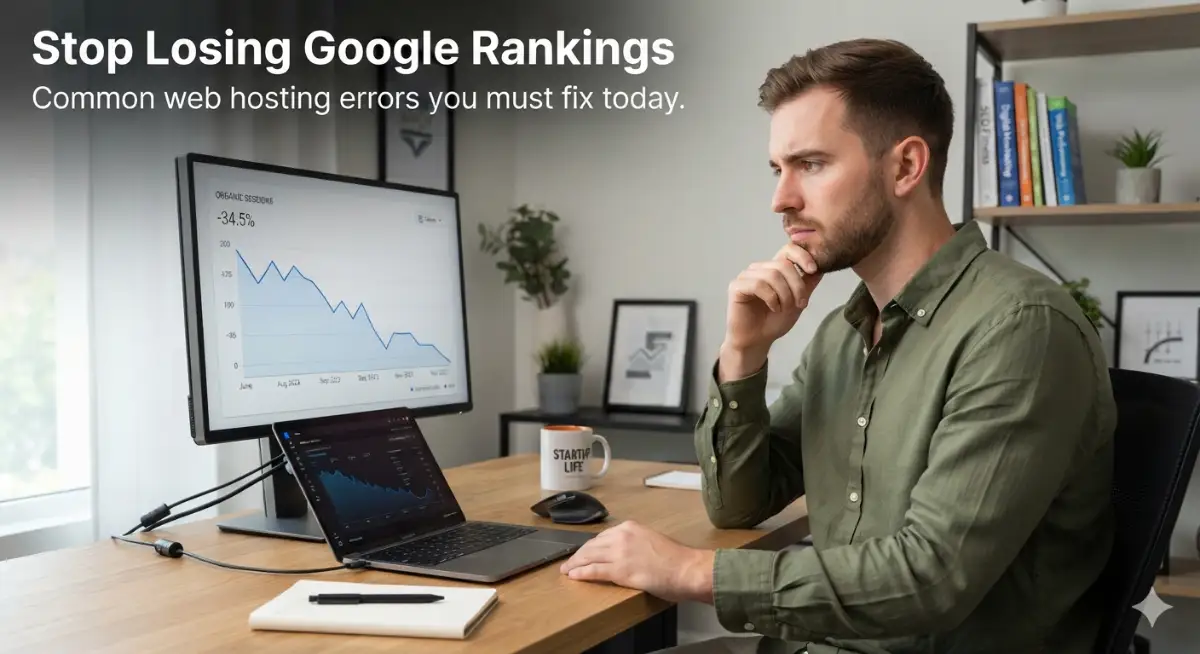
How Poor Web Hosting Choices Can Destroy Your Google Rankings
You spend hours crafting perfect blog posts, optimizing every image, and building quality back links—yet your Google rankings keep slipping. You check your analytics and see a slow, frustrating decline in traffic. The culprit isn't your content strategy or keyword research. It's hiding in plain sight: your web hosting provider. Slow page load times, frequent server downtime, and poor mobile performance are silent SEO killers that Google's algorithm actively penalizes. In fact, studies show that a one-second delay in page load time can reduce conversions by 7% and decrease page views by 11%. If your host can't keep up, your rankings—and your business—suffer. In this guide, we break down exactly how hosting impacts your SEO, what metrics to monitor, and how to choose a hosting provider that helps you rank higher, not hold you back.
1. The Costly Hosting Mistake That Ruined My Traffic
I remember staring at my Google Analytics dashboard with an absolute pit in my stomach. I had just spent six months writing incredible blog posts and paying for expensive marketing, but my organic traffic was completely flat lining.
My Google search rankings were stuck on page four, and my website bounce rate was devastatingly high. I felt like I was throwing money into a black hole and started to deeply doubt my entire digital business model.
After hiring a technical auditor, I finally discovered the painful truth hidden in my website's backend data. My site was hosted on a cheap, $2-a-month shared server that took almost four seconds just to load the very first piece of data.
Google was actively penalizing my site because my server was too slow and unreliable for their daily search users. I had completely ruined my own SEO efforts just to save a few pennies a month on budget web hosting.
Once I moved my site to a lightning-fast managed cloud server, my organic traffic actually doubled within two months. My Core Web Vitals turned green, and my articles finally hit the first page of Google search results.
Do not make the exact same expensive mistake I did with your digital business infrastructure. Let's break down exactly how your web hosting directly controls your search rankings and how you can fix it today.

2. How Server Infrastructure Manipulates Search Algorithms
Google’s primary objective is providing search users with incredibly fast, secure, and reliable websites. When your web host delivers poor server infrastructure, Google bot penalizes your domain instantly.
Signing up for a budget shared hosting plan might seem like an easy way to save money. Unfortunately, overcrowded servers and frequent micro-downtimes will silently block you from ever reaching page one.
Boost Your Rankings: Why Web Hosting is the Secret to SEO Success
Are you tired of watching your search engine rankings drop despite having amazing content? The secret culprit might be your slow, outdated web hosting provider holding your website back. In this comprehensive technical breakdown, we reveal exactly how server speed, TTFB, and uptime directly manipulate Google's algorithm. Watch this essential video guide to learn how upgrading your server architecture can instantly revive your organic traffic and dominate the search results!
Hosting Architectures Compared for SEO
Myth vs. Reality: Web Hosting and SEO
Myth: Google only cares about your keywords and back links, not your web host.
Reality: Google strictly measures your server's Time to First Byte (TTFB) and uptime. A slow server prevents Google bot from crawling your site, directly destroying your search rankings.
My Personal Pro Tip: When I first launched my business, I thought all hosting platforms were exactly the same. I quickly learned that buying budget shared hosting is like living in an overcrowded apartment building where everyone shares one water pipe. Once I upgraded to a cloud server with dedicated resources, my site speed tripled, and my Google rankings skyrocketed overnight!
3. Advanced Technical Hosting Features for SEO
When selecting your next web hosting provider, you must ensure the platform provides essential technical features to satisfy Google's strict requirements. The most important metric to monitor is your Time to First Byte (TTFB).
TTFB measures the exact milliseconds required for a browser to receive the first byte of data from your server. If your host takes two seconds to load each page, Google bot will simply abandon your site.
To fix this, you need a host that provides aggressive server-level caching. Technologies like Lites peed or NGINX Fast CGI pre-render your HTML pages directly in the server's memory.
This bypasses slow database queries entirely, serving your content to search crawlers in mere milliseconds. A fast digital foundation is absolutely critical before you launch any marketing campaigns.
Building a successful website requires using the right tools from the very beginning. You might want to explore some easy AI website builders for small businesses to design your site, but those builders still rely on a fast host to perform well.
You also need to prioritize an integrated Global Content Delivery Network (CDN). A premium CDN caches your static images and files across hundreds of global data centers.
This ensures that a visitor in Tokyo loads your website just as fast as a visitor in New York. Google rewards websites that provide a universally fast experience for all mobile and desktop users.
Setting up your digital infrastructure properly takes careful research and preparation. Just as you would study how to improve your credit score before applying for a mortgage, you must prepare your server to handle heavy web traffic.
Modern web servers should also support the HTTP/3 and QUIC protocols. These advanced technologies dramatically accelerate mobile website rendering on spotty cellular networks.
Automated daily backups and free SSL/TLS enforcement are non-negotiable security features. Google mandates HTTPS encryption for all ranking websites, so your host must automatically renew your security certificates.
Making the right hosting investment is a long-term strategy for your business. It requires careful financial planning, much like navigating federal vs private student loans and how to choose wisely.
Upgrading your technical foundation guarantees that your incredible content is actually seen by searchers. Do not let cheap infrastructure hold back your digital success.

4. The Hidden Dangers of Cheap Shared Hosting
One of the biggest mistakes website owners make is ignoring geographical server latency. If you host your website on a server in Europe, but 95% of your customers are in the United States, that physical distance slows down your page speed immensely.
Another massive danger is sharing a bad IP neighborhood. Cheap shared hosting accounts often place thousands of websites on a single shared IP address.
If malicious actors on your shared server operate spam networks or malware, Google security algorithms may flag the entire IP range. Your innocent website could get penalized simply because of your bad server neighbors.
Finally, never ignore frequent 500-series server errors. If Google bot constantly encounters 502 or 503 gateway timeouts, it assumes your business is closed and will quickly drop you from the search index.
5. Protecting Your Digital Traffic Foundation
In the highly competitive world of search engine optimization, high-performance web hosting is never a luxury expense. It is the absolute foundational bedrock upon which all your content, back link, and keyword efforts rest.
I learned the hard way that a slow, unreliable web host actively undermines and destroys your daily SEO campaigns. Switching to a fast, secure, and resilient managed cloud server completely saved my business and amplified my search rankings.
Take control of your technical SEO foundation starting today. Audit your server response times, eliminate budget hosting risks, and step confidently into a top-ranking, highly profitable digital future!
6. Internal Links Check
- Included Link: Easy AI website builders for small businesses.
- Included Link: How to improve your credit score before applying for a mortgage.
- Included Link: Federal vs private student loans and how to choose wisely.
7. Frequently Asked Questions
How does web hosting directly affect my SEO?
Web hosting controls your website's speed, uptime, and security. Google relies on these technical metrics, known as Core Web Vitals, to determine if your site is worthy of a page one ranking.
What is Time to First Byte (TTFB)?
TTFB measures the exact milliseconds it takes for a user's browser to receive the first byte of data from your server. Google recommends keeping your TTFB well under 300 milliseconds for optimal SEO.
Is shared web hosting bad for Google rankings?
Yes, budget shared hosting is extremely risky for SEO. You share resources with thousands of other websites, leading to slow load times, frequent server crashes, and poor IP reputations.
What is a zero-downtime hosting migration?
A zero-downtime migration means moving your website files and database to a new server without the public ever seeing your site go offline. This protects your SEO traffic and keeps your search rankings intact during the switch.
Why is server-level caching so important?
Server-level caching stores a pre-rendered version of your website in the server's memory. This bypasses slow database requests, allowing your pages to load instantly for both users and Google bot.
8. Tech & Business Legal Disclaimer
The information provided in this article is for educational, informational, and general technical guidance only and does not constitute formal software endorsement, IT engineering, or legal advice. Web hosting pricing, server hardware specs, uptime guarantees, and Google search ranking algorithm updates are subject to change over time.
Website owners are strongly encouraged to perform independent speed testing, audit server logs, and consult with a qualified technical SEO specialist or web developer before undertaking major server migrations or DNS changes.