
Introduction: Scaling Your Online Business with Artificial Intelligence
Running an online business in today's hyper-competitive digital landscape is an exhilarating yet demanding experience. Whether you manage an e-commerce storefront, operate a digital agency, sell online courses, or run a software-as-a-service (SaaS) platform, you face constant pressure to attract new website traffic, convert visitors into paying customers, and deliver instant 24/7 customer support. Doing all of this manually requires endless hours of hard work, resulting in high operating expenses and founder burnout.
In recent years, rising digital advertising costs, changing privacy regulations, and shifting search engine algorithms have made traditional online marketing strategies significantly more expensive and less effective. Online entrepreneurs are finding that simply working longer hours is no longer enough to maintain healthy profit margins or outpace market competitors.
This is where artificial intelligence acts as a game-changing force multiplier. AI technology is no longer an abstract concept reserved for giant tech corporations; it has become an accessible, user-friendly suite of digital business tools. From automated lead scoring and personalized email marketing to 24/7 AI customer support bots and predictive inventory analytics, AI empowers online business owners to scale operations, cut costs, and boost revenue fast. Let us explore how you can use artificial intelligence to grow your online business today!
A Personal Reflection on Digital Burnout
I still remember running my e-commerce store three years ago, working sixteen-hour days trying to write dozens of product descriptions, design social media ad banners, write weekly newsletters, and answer customer support emails at 2:00 AM. I felt completely overwhelmed, exhausted, and stuck on a treadmill of manual execution. Implementing our first automated AI customer chat assistant and AI email sequence generator transformed my business. We cut response times from hours to seconds while increasing our checkout conversion rate by 35%. That transition taught me that growing an online business isn't about working yourself to exhaustion—it's about leveraging smart AI systems to do the heavy lifting for you.
Why Traditional Online Growth Strategies Are Lagging Behind
Online business owners face severe operational hurdles when relying purely on manual workflow processes:
- Surging Customer Acquisition Costs (CAC): Paid ad channels (like Meta and Google) have become significantly more expensive, requiring higher ad conversion rates to remain profitable.
- High Shopping Cart Abandonment Rates: Online shoppers leave websites without buying when their questions about shipping, sizing, or return policies aren't answered instantly.
- Inconsistent Content Creation Schedules: Producing regular search engine optimized (SEO) articles, email newsletters, and social posts manually takes immense time, leading to spotty marketing output.
- Generic, One-Size-Fits-All Customer Experiences: Modern digital consumers expect tailored product recommendations. Displaying identical static homepage layouts to every visitor reduces sales conversions.
Core Areas Where AI Drives Online Business Expansion
Integrating AI tools across your digital storefront or agency unlocks rapid, scalable growth opportunities:
- Hyper-Personalized Shopping Experiences: AI recommendation engines analyze browsing history, past purchases, and real-time visitor behavior to display dynamic product recommendations, increasing average order value (AOV).
- 24/7 Conversational AI Chatbots: Smart AI customer service bots answer complex buyer questions, track shipping orders, and guide visitors through checkout around the clock.
- Automated Content & SEO Production: AI generators draft high-ranking blog articles, compelling email subject lines, product copy, and meta tags in minutes.
- Predictive Inventory & Pricing Analytics: Machine learning algorithms forecast seasonal product demand spikes, preventing stockouts and optimizing dynamic price points for maximum profit margins.
There is a unique feeling of empowerment when you open your business analytics dashboard in the morning and see that your AI sales assistant automatically answered questions for late-night international shoppers, recovered five abandoned carts, and generated $1,200 in revenue while you slept peacefully. Technology is no longer an intimidating corporate barrier—it is an accessible digital team working tirelessly to help you succeed.
 5 Practical AI Implementation Strategies for Online Business Owners
You do not need an advanced engineering background to deploy artificial intelligence. Implement these five straightforward AI strategies to boost your online revenue:
- Deploy AI-Powered Personalization Engines: Integrate smart personalization widgets onto your website homepage and product pages. AI engines track user interaction signals, automatically displaying "Frequently Bought Together" sections and personalized discount offers that significantly lift conversion rates.
- Automate Email Marketing & Cart Abandonment Workflows: Set up AI-driven email marketing platforms that analyze open times, click patterns, and purchase history. AI tools automatically send personalized abandoned cart reminders, product re-engagement emails, and post-purchase follow-ups at the exact time a customer is most likely to buy.
- Install a 24/7 AI Conversational Customer Support Bot: Deploy conversational AI widgets (such as Tidio, Lyro, or Gorgias AI) trained on your website FAQs, policy documents, and product catalogs. These bots answer customer inquiries in under five seconds, resolving up to 70% of routine tickets autonomously without human intervention.
- Utilize AI Creative Tools for Paid Ad Campaigns: Testing multiple ad variations is critical for paid acquisition success. Use AI ad generators (like AdCreative.ai) to create dozens of ad images, video scripts, and headline copy variations in minutes, allowing machine learning ad algorithms to optimize for the lowest cost-per-click.
- Leverage AI Content Tools for Inbound SEO Rankings: Accelerate your organic search rankings by using AI tools to research long-tail keywords, outline comprehensive blog posts, and write product descriptions. Always add human editing and personal stories to AI-generated copy to ensure high content quality and brand authenticity.
AI Application Area Comparison Matrix
Myth vs. Reality of Artificial Intelligence in Business
- Myth: Implementing artificial intelligence requires a massive budget and a dedicated IT development team.
- Reality: Most modern AI solutions are cloud-based, subscription-friendly SaaS plugins that integrate into standard website builders within minutes.
- Myth: AI-generated marketing messages feel robotic and alienate loyal brand customers.
- Reality: When combined with custom brand guidelines and human review, AI generates highly tailored, empathetic communication that delights buyers.
My Personal Pro Tip: When I first began experimenting with AI marketing copy, I made the mistake of publishing outputs directly without review, which lacked my authentic brand voice. My advice to you is to always use AI as a brilliant 80% draft generator, leaving the final 20% of editing for your personal stories and brand adjustments.
Visual Insight: Master Business AI Automations
In the past business automation was a simple workflow that softwares followed for example in your email marketing we'd fill in variables. but now with AI. that's changed drastically. and I want to cover some of the best AI automation softwares for your business. today. Watch this helpful video breakdown to discover cutting-edge systems and workflow optimizations!
Step-by-Step Blueprint: Integrating AI Into Your Business
Follow this 5-step blueprint to integrate artificial intelligence into your online business smoothly:
Step 1: Identify Friction Points in Your Sales Funnel
Analyze your web analytics. Are visitors dropping off at checkout? Are support inquiries overwhelming your inbox? Choose the single biggest bottleneck and solve it with AI first.
Step 2: Feed AI Tools Accurate Business Data
AI tools rely on data quality. Upload your official product documentation, shipping policies, and brand voice guidelines into your AI tools so they generate accurate responses.
Step 3: Connect Tools via No-Code Workflow Automations
Use no-code tools (like Zapier or Make.com) to link your AI tools together. Automatically push website lead data directly into your CRM, email sequences, and team dashboards.
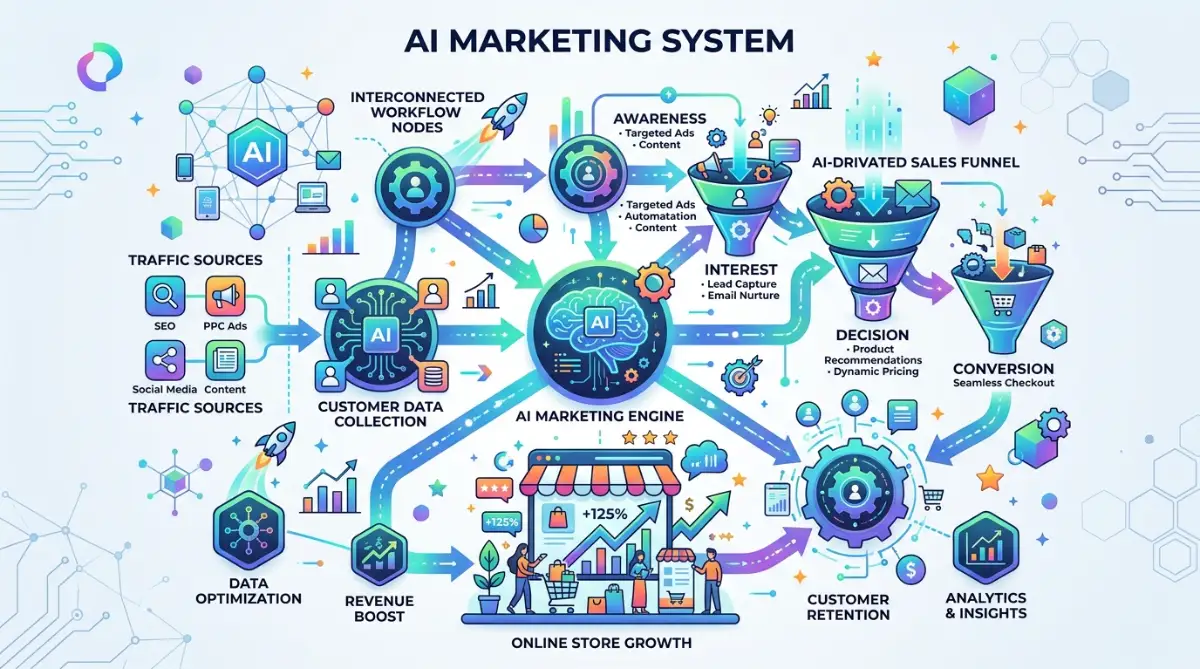
As your online enterprise expands past its initial setup phase, maintaining clean data hygiene and coherent system architecture becomes paramount. When multiple AI applications handle different aspects of your business—such as automated email segmentation, inventory forecasting, and real-time user chat interactions—ensuring they communicate seamlessly prevents fragmented customer experiences. Advanced founders establish rigorous monitoring frameworks to audit automated workflows weekly, verifying that token limits, API response speeds, and customer satisfaction scores remain optimized.
Additionally, cultivating a data-driven culture among your human team members accelerates overall productivity. When customer support agents partner alongside AI routing bots, they spend less time answering repetitive tracking queries and more time resolving complex, high-value client issues. Similarly, digital marketers can leverage predictive AI analytics to test seasonal campaigns faster, pivoting ad spend toward winning creative variations before competitors notice market trends shifting.
Common Mistakes & Pitfalls to Avoid
While artificial intelligence offers incredible leverage, improper implementation can harm your brand reputation and waste valuable capital. Here are common pitfalls to dodge:
- Over-Automating Sensitive Customer Issues: Never rely on automated bots for complex billing disputes, angry customer complaints, or high-tier enterprise relationship management that require genuine human empathy.
- Failing to Proofread AI Outputs: Publishing raw, unedited AI-generated content can introduce factual inaccuracies, generic buzzwords, and brand voice inconsistencies.
- Ignoring Data Privacy Compliance: Avoid pasting confidential customer financial details or proprietary trade secrets into public AI models that do not guarantee enterprise-grade data protection.
- Subscribing to Too Many Tools Prematurely: Adopting dozens of overlapping AI applications without a unified integration plan leads to software fatigue and bloated monthly operating expenses.
Stepping Into the Role of a True Founder
At the end of the day, artificial intelligence isn't meant to replace the human creativity, passion, and personal relationships behind your brand—it is designed to free you from repetitive execution tasks. When AI handles support tickets, data entry, and email automation, you step off the operational hamster wheel. You gain the time and mental clarity required to innovate, launch new products, and build a meaningful business that serves your life.
Quick Guide: AI Business Adoption Do's and Don'ts
Your 30-Day AI Growth Action Checklist
- Week 1: Deploy AI Chatbot: Install a conversational AI widget (like Tidio/Lyro) on your store to capture 24/7 leads.
- Week 2: Set Up Abandoned Cart Workflows: Enable AI predictive email recovery triggers in your email platform.
- Week 3: Automate Ad & Copy Generation: Test AI marketing generators (like AdCreative) for social media ad campaigns.
- Week 4: Review Metrics & Scale: Track conversion rate lifts, refine AI prompts, and connect systems via Zapier.
Scaling a profitable online business no longer requires a massive corporate budget or an army of full-time staff. By deploying smart artificial intelligence tools across your sales, marketing, and customer support channels, you eliminate operational bottlenecks and drive scalable, hands-free growth. Take action today and build the automated, future-proof online business you deserve!
Reflecting on my own entrepreneurial path, my biggest breakthrough happened the moment I stopped trying to do everything manually and learned to trust digital systems. I want you to escape that same exhausting cycle of burnout by testing a single automation tool this week. If you ever need guidance on structuring your tech stack or optimizing your online revenue streams, remember that I am rooting for your success every step of the way.
Additional Financial & Business Resources
Managing operational expenses and cash flow effectively ensures long-term business survival. Explore our specialized guides:
- Building liquid cash reserves requires smart planning; read our guide on managing insurance protection and risk buffers to safeguard your digital assets.
- For small business web development and platform setup strategies, check out this simple configuration overview on easy AI website builders for small businesses.
- If you are balancing personal founder credit lines or securing startup funding, learn how to manage debt efficiently via improving credit scores before corporate applications.
- For alternative educational pathways and affordable upskilling resources for your team, review insights on affordable educational opportunities.
- To evaluate borrowing structures versus bootstrapping, understand funding options through choosing financial loans wisely.
Frequently Asked Questions (FAQs)
Is AI expensive for a small online business?
Not at all! Most SMB AI tools offer free tiers or entry-level plans starting between $10 and $30 per month, delivering an immediate return on investment by saving dozens of manual labor hours.
Will using AI content hurt my website's Google SEO rankings?
Google officially rewards high-quality, helpful content regardless of how it is produced. As long as you edit AI draft content for accuracy, add human perspective, and provide genuine value, AI content performs exceptionally well in search rankings.
Can AI chatbots replace human customer support agents entirely?
AI chatbots can resolve up to 70% of routine, repetitive inquiries autonomously, but human agents remain necessary for complex troubleshooting, emotional empathy, and high-value customer relations.
What is the easiest AI tool to start with for e-commerce stores?
Conversational AI chat assistants like Tidio Lyro or automated abandoned cart email plugins like Klaviyo AI are generally the easiest tools to deploy with immediate revenue impact.
How do I ensure my business data remains secure when using AI tools?
Always review software vendor privacy policies to ensure your proprietary customer data is not utilized to train public foundational AI models without enterprise consent.
Disclaimer: This article is published exclusively for educational and informational purposes. It does not constitute formal software procurement, financial, or corporate consulting advice. Software features, pricing tiers, and AI platform capabilities evolve constantly. Always review official vendor documentation prior to purchasing software subscriptions for your organization. Author: Md Jahangir Alam