
How I Discovered the Shocking Truth About IRS Crypto Rules
Three years ago, I made my first major cryptocurrency trade during a wild market rally. I watched my initial investment double in a matter of weeks, swapping Bitcoin for several promising altcoins.
I felt like a financial genius until April rolled around and tax season arrived. I received a surprise letter from the IRS asking about my digital asset activity for the previous year.
My heart dropped into my stomach when I realized that every single altcoin swap was a taxable event. I had mistakenly assumed that taxes were only owed when converting crypto back into US dollars cash.
That single misunderstanding left me scrambling through hundreds of transaction records across four different exchanges. I spent sleepless nights calculating cost basis numbers and filling out complex tax schedules.
That stressful experience forced me to learn the US tax code inside and out. Today, I am going to break down everything you need to know about IRS digital asset rules so you can avoid my costly mistakes.
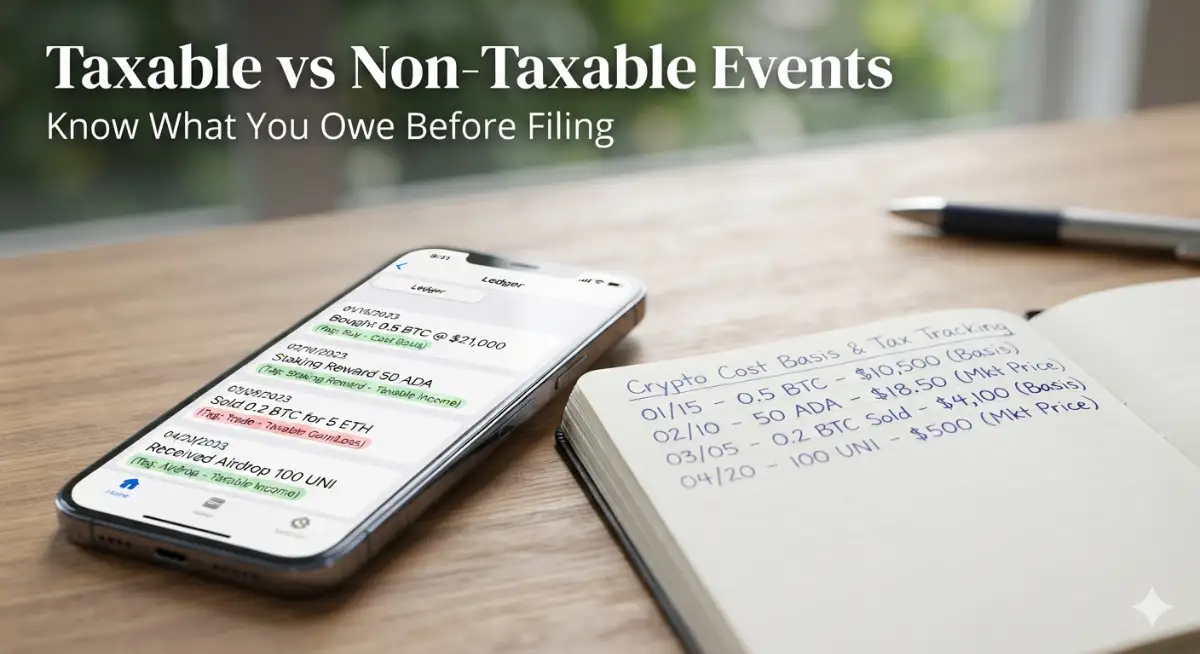
Navigating digital asset taxes in the United States can feel scary, but understanding the basics puts you in total control. The Internal Revenue Service (IRS) has significantly increased its focus on digital assets over the past few years.
Every standard IRS Form 1040 now features a prominent question right at the top asking if you received, sold, or exchanged any digital assets. Ignoring this question or failing to report your activity accurately can lead to heavy penalties, interest charges, or unwanted audits.
Fortunately, once you understand how the IRS classifies digital currencies, tracking your obligations becomes straightforward. Let's walk through the core rules step by step so you can stay fully compliant while keeping more of your hard-earned gains.
The Plain-English Breakdown of US Crypto Tax Laws
The most important concept to grasp is how the US government views digital currencies under tax law. The IRS does not classify Bitcoin, Ethereum, or any other token as real currency.
Instead, IRS Notice 2014-21 classifies all digital assets as property. This means cryptocurrency is treated exactly like stocks, real estate, or precious metals for tax purposes.
Whenever you trade, sell, or dispose of property, you trigger a potential capital gain or capital loss that must be reported on your tax return.
Taxable vs. Non-Taxable Crypto Events
Not every transaction you make in the Web3 ecosystem requires paying money to the government. Understanding the boundary between taxable and non-taxable events saves you time and prevents overpaying.
1. Common Taxable Events (You Owe Taxes)
- Selling Crypto for USD or Other Fiat Currency: If you buy Bitcoin for $2,000 and sell it later for $5,000, you have a taxable capital gain of $3,000.
- Trading One Crypto for Another Crypto: Swapping Ethereum for Solana is classified as selling your Ethereum at fair market value to purchase Solana. You must calculate your gain or loss on the Ethereum at the exact moment of the trade.
- Buying Goods or Services with Crypto: Using Bitcoin to buy a cup of coffee or a new laptop is treated as selling your property to make the purchase.
- Earning Crypto Income: Receiving digital tokens from mining, staking rewards, yield farming, or as payment for work is taxed immediately as ordinary income based on its dollar value when received.
2. Common Non-Taxable Events (No Taxes Owed)
- Buying Crypto with US Dollars: Purchasing digital coins with fiat currency and holding them in an account is not a taxable event.
- Transferring Crypto Between Your Own Wallets: Moving tokens from a Coinbase account to a hardware wallet like a Ledger does not trigger a tax event.
- Gifting Crypto: Giving digital assets as a gift to someone else is generally non-taxable as long as the value is under the annual gift exclusion threshold ($18,000 per recipient).
- Donating Crypto to Qualified Charities: Donating digital assets directly to registered 501(c)(3) non-profit organizations is non-taxable and can provide a valuable tax deduction.
Short-Term vs. Long-Term Capital Gains Rates
How much tax you pay on your profitable transactions depends heavily on how long you held the asset before disposing of it. The IRS divides capital gains into two distinct categories:
Short-Term Capital Gains
If you hold a digital asset for one year or less before selling or trading it, any profit is classified as a short-term capital gain. Short-term gains are taxed at your ordinary income tax rate, which ranges from 10% to 37% depending on your total annual income bracket.
Long-Term Capital Gains
If you hold a digital asset for more than one year before disposing of it, your profit qualifies for long-term capital gains treatment. Long-term tax rates are significantly lower than ordinary income rates, topping out at 0%, 15%, or 20% depending on your taxable income level.
Holding your digital assets for at least 366 days before selling is one of the simplest ways to cut your tax bill nearly in half.
Understanding IRS Cost Basis Calculations
To determine your exact profit or loss on a trade, you must know your cost basis. Your cost basis is the original purchase price of the asset, plus any transaction or gas fees you paid during the purchase.
When you sell or trade that asset later, your capital gain or loss is calculated using a simple formula:
Capital Gain/Loss = Selling Price (Minus Fees) - Cost Basis
For example, if you buy 1 ETH for $2,000 and pay $20 in network gas fees, your total cost basis is $2,020. If you sell that 1 ETH later for $3,000 and pay $30 in selling fees, your net proceeds are $2,970.
Your taxable capital gain would be $2,970 minus $2,020, which equals $950.
When selling portions of a large token holding acquired at different times and prices, the IRS allows specific inventory accounting methods:
- FIFO (First In, First Out): Assumes the earliest coins you bought are the first ones you sell. This is the default method used by the IRS.
- LIFO (Last In, Last Out): Assumes the most recent coins you bought are the first ones sold.
- HIFO (Highest In, First Out): Assumes the highest-cost coins are sold first, which minimizes your immediate capital gains.
Essential IRS Tax Forms for Crypto Reporting
Filing your tax return correctly requires submitting specific forms alongside your standard Form 1040. Here are the main tax documents you need to understand:
- Form 1040 (Digital Asset Question): You must check "Yes" or "No" on the main tax form confirming whether you engaged in digital asset transactions during the tax year.
- Form 8949 (Sales and Other Dispositions of Capital Assets): Every single taxable crypto trade, sale, or spend must be itemized on this form, listing purchase dates, sale dates, proceeds, cost basis, and resulting gains or losses.
- Schedule D (Capital Gains and Losses): This form summarizes your total short-term and long-term capital gains or losses from Form 8949 and transfers the final total to your Form 1040.
- Schedule 1 (Additional Income and Adjustments): Used to report ordinary income earned from staking rewards, mining, airdrops, or referral bonuses.
- Form 1099-DA / 1099-MISC / 1099-B: Major US brokers and centralized exchanges send these information returns to both you and the IRS reporting your annual activity.
US Crypto Activity Classification Guide
Debunking Common US Crypto Tax Myths
- Myth 1: The IRS cannot track transactions made on decentralized exchanges or private wallets.
- Reality: The IRS uses sophisticated blockchain analytics software to trace wallet addresses across public ledgers. Furthermore, US exchanges report user transaction data directly to the government.
- Myth 2: You only owe taxes when you cash out your crypto into a traditional bank account.
- Reality: Swapping one coin for another or buying an item with digital currency is a disposal of property. You owe capital gains tax at the exact moment of the trade, regardless of whether fiat cash touches your bank account.
- Myth 3: You have to pay taxes when you transfer coins from an exchange to a hardware wallet.
- Reality: Moving your own assets between self-custody wallets or exchange accounts is completely non-taxable. You are simply changing where your property is stored.
My Personal Pro Tip: Whenever the crypto market experiences a downturn, I take advantage of a powerful strategy called tax-loss harvesting! I deliberately sell losing positions to lock in capital losses. I can use those losses to offset all of my capital gains plus up to $3,000 of my ordinary W-2 income each tax year!
If you want a quick visual explanation of how the IRS taxes your digital assets, watch this helpful video below:
Advanced Strategies to Lower Your Crypto Tax Bill Legally
Understanding the rules allows you to organize your portfolio strategically to minimize what you legally owe each tax season. Smart planning transforms tax preparation from a scary burden into a powerful wealth-building tool.
The first strategy is utilizing Tax-Loss Harvesting. If you bought an altcoin for $5,000 and it drops in value to $2,000, selling that asset locks in a $3,000 capital loss.
You can use that $3,000 loss to offset $3,000 in capital gains made from selling Bitcoin or stocks. If your losses exceed your total gains for the year, you can use up to $3,000 of remaining losses to reduce your regular W-2 salary income, carrying forward any extra unused losses into future tax years indefinitely.
The second strategy is investing through a Crypto Roth IRA. When you buy digital assets inside a specialized Roth IRA account, your investments grow completely tax-free.
You do not owe a single dollar in capital gains taxes when you trade inside the account or when you withdraw your funds during retirement. This is an incredible vehicle for long-term investors who want to compound wealth without filing yearly trade reports.
The third strategy is maintaining meticulous digital records using specialized crypto tax software. Trying to manually calculate cost basis across multiple decentralized platforms, staking protocols, and exchanges is nearly impossible.
Modern crypto tax software connects directly to your exchange accounts and public wallet addresses via read-only API keys. The software automatically reconciles your trades, calculates cost basis using HIFO or FIFO rules, and generates completed Form 8949 documents ready for TurboTax or your CPA.
If you are managing your broader personal financial setup alongside investments, staying organized is essential. For instance, learning how to improve your credit score before applying for a mortgage helps you build a solid financial base while keeping your investment portfolio clean.
Similarly, if you are balancing educational expenses or family budgets, reviewing federal vs private student loans: how to choose wisely ensures your daily cash flow remains healthy.
Students attending the best community colleges in the USA for affordable education often save thousands on tuition, leaving them with more capital to invest safely.
Finally, protect your overall wealth by securing proper insurance coverage. Just as understanding how to choose your first home insurance policy without stress safeguards your physical home, staying on top of tax compliance protects your digital wealth from unexpected government penalties.
If you run a business or side hustle alongside investing, exploring easy AI website builders for small businesses helps you keep operational costs low so you can allocate more funds toward long-term savings.

Major Mistakes That Lead to IRS Audits and Penalties
Failing to understand digital asset tax rules can result in severe financial damage. One of the most common mistakes investors make is assuming that small trades or crypto-to-crypto swaps do not need to be reported.
Every single trade is recorded permanently on transparent public blockchains. When exchanges issue Form 1099 records to the IRS and your personal tax return does not match those figures, automated audit flags are triggered immediately.
Another major pitfall is ignoring gas fees and transaction costs when computing your cost basis. High Ethereum gas fees paid during network congestion can be added directly to your purchase cost basis or subtracted from your sales proceeds.
Forgetting to include these network fees means overreporting your net profits and paying more tax than you legally owe.
Lastly, never assume that losing access to an exchange or losing private keys excuses you from reporting obligations. If you lost funds in a platform collapse or wallet hack, documenting those events properly with a CPA is necessary to account for missing assets on your tax forms.
Taking Control of Your Crypto Tax Journey Today
Understanding US crypto taxes does not have to be a nightmare. When you break down the rules into clear categories, you can manage your portfolio with complete confidence.
By tracking your cost basis, holding assets long-term, and utilizing tax-loss harvesting, you protect your hard-earned profits while staying fully compliant with IRS regulations.
I hope this guide gives you the clarity you need to approach tax season without fear. Take control of your records today, connect your wallets to a reliable tax tracker, and enjoy the peace of mind that comes with financial organization!
Frequently Asked Questions About US Crypto Taxes
Do I have to pay taxes if I lost money trading crypto in the USA?
No, you do not pay taxes on crypto losses. In fact, realized capital losses can be used to offset your capital gains from other investments or reduce up to $3,000 of your ordinary income each tax year.
What happens if I do not report my crypto on my US tax return?
Failing to report crypto transactions can lead to IRS audit flags, failure-to-pay penalties, compounding interest charges, and potential legal consequences for tax evasion.
Is transferring crypto between Coinbase and a Ledger wallet taxable?
No, transferring digital assets between wallets or exchange accounts that you personally own is non-taxable. It is simply moving property from one storage location to another.
How does the IRS know if I trade cryptocurrency?
US-based centralized exchanges submit Form 1099 information returns directly to the IRS containing your name and transaction volume. Additionally, the IRS uses advanced blockchain analytics tools to trace public wallet addresses.
What tax rate do I pay on crypto staking rewards?
Crypto staking rewards are classified as ordinary income and are taxed at your standard federal income tax rate based on the fair market dollar value of the tokens on the day you received them.
Category Disclaimer
The information provided in this article is for educational and informational purposes only and does not constitute formal tax, legal, or financial advice. IRS tax regulations regarding digital assets change frequently. Always consult with a qualified Certified Public Accountant (CPA) or licensed tax professional regarding your personal tax situation.