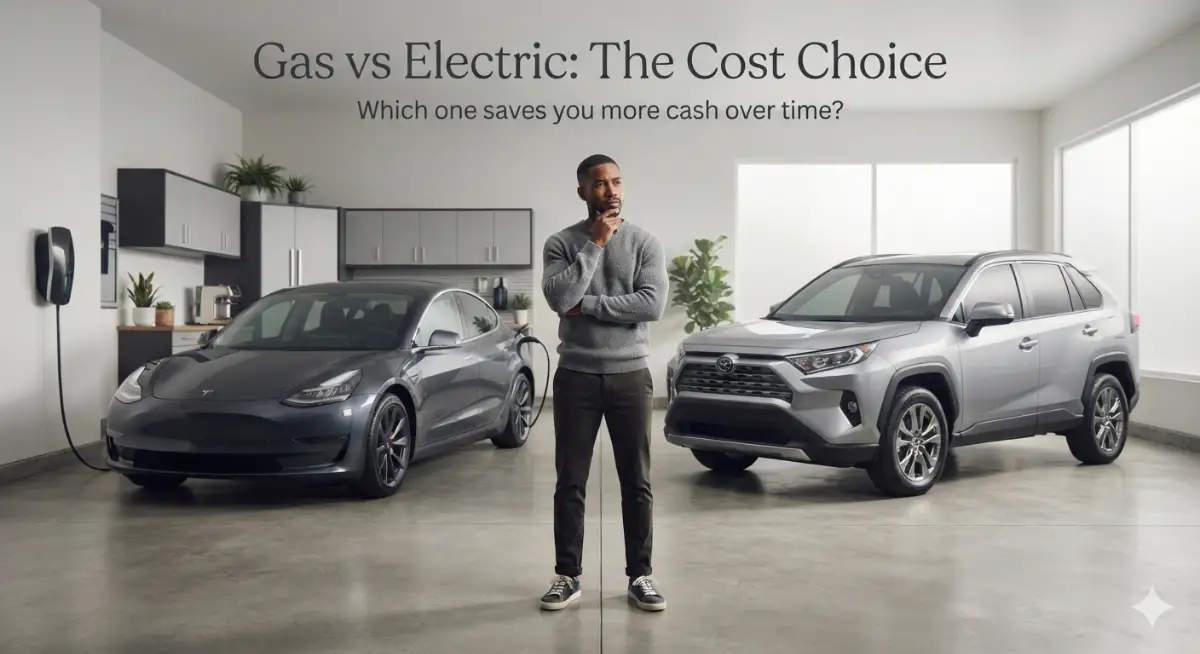
Gas vs. Electric Cars: The True Cost of Ownership Revealed
Are you wondering whether buying an electric vehicle will actually save you money compared to a traditional gas car? While electric cars often carry a higher upfront sticker price, their lower daily operating expenses, zero oil changes, and massive federal tax credits can change the financial math completely. In this comprehensive guide, we break down the true 5-year Total Cost of Ownership—covering fuel savings, home charging economics, insurance, and maintenance bills. Discover which power train truly keeps more money in your pocket over the long run!
When standing on a dealership lot or browsing online auto listings, one of the most defining financial decisions an American consumer faces today is choosing between a traditional Internal Combustion Engine gasoline vehicle and an All-Electric Vehicle. For over a century, gas-powered cars served as the undisputed backbone of personal mobility in North America. Today, however, as automobile manufacturers invest hundreds of billions of dollars into electrification and national charging infrastructure continues to expand, buyers are increasingly torn between the familiar convenience of gas stations and the modern promise of fuel-free electric driving. When I first began crunching the numbers between buying a conventional gas sedan and an electric crossover, I felt completely overwhelmed by conflicting online claims about hidden expenses. Like many consumers, I saw the higher upfront sticker price on the electric model and worried that the long-term savings might not actually materialize in real life. I knew I needed to look past surface-level pricing and build a complete total cost of ownership model based on actual insurance, maintenance, and energy data. Taking time to map out every single ownership expense completely cleared my doubts, proving that electric vehicles offer profound long-term financial advantages for regular commuters.
However, comparing gas versus electric vehicles solely by looking at the initial window sticker price is a dangerous financial mistake. The true financial impact of vehicle ownership is defined by Total Cost of Ownership—a comprehensive mathematical equation that factors in initial purchase price, federal and state tax incentives, annual fuel versus electricity costs, routine mechanical maintenance, insurance premiums, home charging installation, and 5-year depreciation rates.
While electric vehicles frequently carry a higher upfront sticker price, their lower daily operating expenses and maintenance bills can drastically offset that initial price premium over time. In this comprehensive guide, we dissect the true cost of owning gas versus electric cars side-by-side, breaking down real-world financial data to help you determine which power train saves you more money over 5 to 10 years.
1. Upfront Sticker Price, Financing, and Federal Tax Incentives
The initial purchase phase is where traditional gasoline cars retain a clear advantage in entry-level affordability, although government incentives narrow the gap significantly:
- Base MSRP Comparison: Entry-level gasoline compact sedans and crossovers typically start between $24,000 and $32,000, whereas long-range electric vehicles generally range between $35,000 and $48,000 before tax credits. For related financing help, review our guide on managing educational loans and smart family budgeting.
- IRS Section 30D Clean Vehicle Tax Credit ($7,500): Under US tax law, eligible new electric vehicles assembled in North America with battery components meeting critical mineral rules qualify for an instant $7,500 point-of-sale tax credit discount applied directly at the dealership register.
- IRS Section 25E Used EV Tax Credit ($4,000): Pre-owned electric vehicles selling for $25,000 or less qualify for a $4,000 or 30% tax credit discount, making used EVs exceptionally affordable.
- State & Utility Rebates: Many US states and local electric utilities offer additional cash rebates ranging from $1,000 to $5,000 for EV purchases and home Level 2 charger installations.
To analyze broader consumer spending economics and automotive ownership budgeting strategies, explore our comprehensive analysis of consumer financial planning and green energy economics.
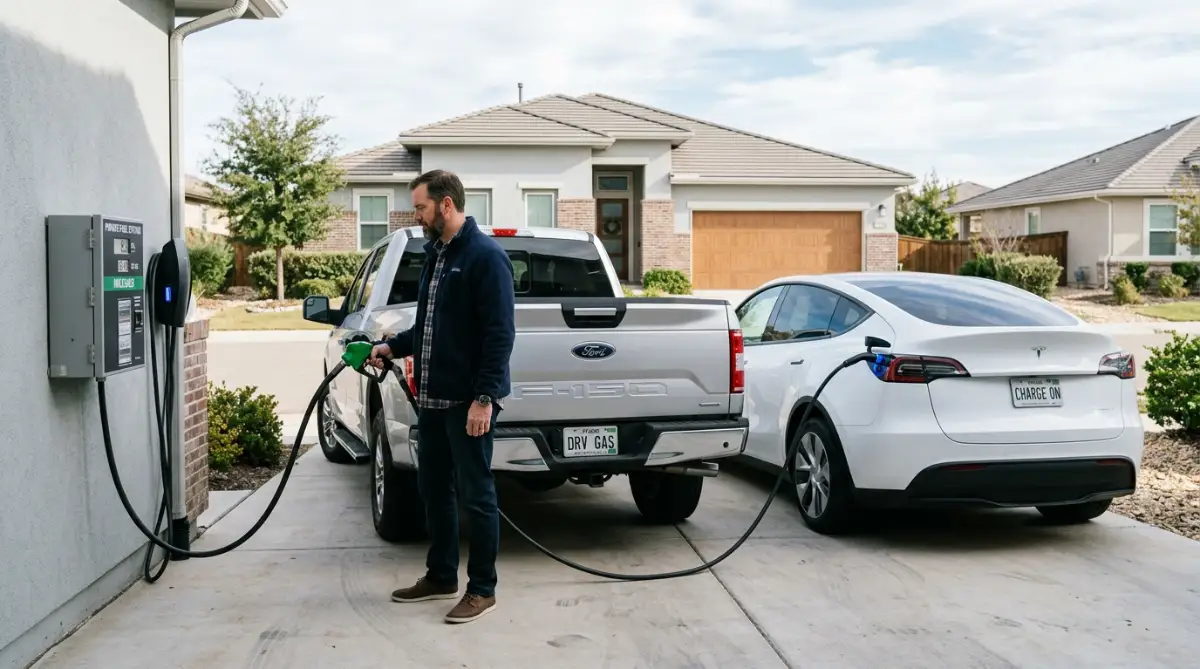
2. Energy Costs: Gasoline Fill-Ups vs. Home Overnight Electricity
Daily operating fuel expense represents the single largest area where electric vehicles deliver massive financial savings compared to internal combustion engines:
My Personal Pro Tip: Whenever I evaluate vehicle energy expenses, I always emphasize programming your EV or home smart charger to activate only during late-night utility off-peak hours. In my experience, shifting your charging schedule to run between midnight and 6:00 AM cuts your electricity rates in half, maximizing your daily fuel savings.
Watch this video guide for an expert video comparison calculating exact fuel, energy, towing, and maintenance expenses between gasoline V8 engines and electric power trains:
3. Scheduled Maintenance and Mechanical Repairs
The mechanical difference between gas and electric power trains explains why maintenance bills diverge so drastically over 100,000 miles:
- What Gasoline Cars Must Maintain: A gas car contains an engine block with pistons, valves, timing belts, fuel injectors, spark plugs, alternators, water pumps, torque converters, and multi-gear automatic transmissions that wear out over time. Learn how to protect your personal finances by reading our guide on improving your credit score before applying for financial products.
- What Electric Vehicles Maintain: An electric drivetrain eliminates all internal engine parts. EV maintenance focuses primarily on tires, cabin air filters, windshield wiper fluid, and brake fluid tests. You can also explore how to protect your household investments by reading our guide on choosing a home insurance policy without stress, or check out our suggestions on simple website building tools for small businesses if you manage a remote side venture.
4. Insurance Rates, Depreciation, and Resale Value Factors
To calculate an accurate 5-year Total Cost of Ownership, buyers must account for insurance premiums and depreciation:
- Insurance Premium Differences: Electric vehicles currently cost 10% to 15% more to insure on average compared to gas cars due to higher high-voltage component repair costs and specialized body shop labor rates.
- Depreciation Rates: Early-generation EVs suffered steep initial depreciation due to rapid battery technology improvements. However, modern EVs with liquid-cooled batteries hold resale values significantly better, backed by mandatory 8-year / 100,000-mile federal high-voltage battery warranties.

5. Common Pitfalls to Avoid When Calculating TCO
Even smart shoppers can miscalculate their total cost of ownership if they make incorrect assumptions about fuel or charging habits. A common mistake is assuming that public DC fast charging is just as cheap as home overnight charging; relying exclusively on public fast chargers can double your energy expenses. Another pitfall is forgetting to check insurance rate quotes before buying, as EV premiums can vary significantly depending on your zip code and driving record. Always run a complete, localized financial comparison.
6. The Master 5-Point Total Cost Decision Checklist
Before deciding whether a gas or electric vehicle fits your garage, run your numbers through this 5-point checklist:
- Step 1: Calculate Annual Commute Mileage: If you drive over 12,000 miles per year, an electric car's fuel savings will easily offset its initial price premium.
- Step 2: Verify Home Charging Access: Confirm you can install a 240V Level 2 charger in your garage or driveway to maintain low energy costs.
- Step 3: Check IRS Federal Tax Credit Eligibility: Verify whether your household Adjusted Gross Income qualifies for the Section 30D tax credit.
- Step 4: Compare Insurance Quotes in Advance: Request side-by-side auto insurance rate quotes for both gas and electric models.
- Step 5: Factor in Maintenance Reductions: Subtract $500 per year from your operating budget for eliminated oil changes and engine services.
7. Final Thoughts and Moving Forward
The debate between gas and electric vehicles is not about ideology; it is a mathematical calculation based on your driving habits, charging access, and annual mileage. Gasoline cars continue to offer low initial purchase prices and rapid refueling for long-distance rural road trips. However, for commuters and families with home charging access, electric vehicles deliver unmatched daily operating savings, whisper-quiet performance, and significantly lower lifetime maintenance bills.
In my own driving experience, calculating the complete 5-year total cost of ownership revealed that my electric vehicle was thousands cheaper than a comparable gas car over the long run. Evaluate your daily driving routine, calculate your 5-year Total Cost of Ownership, test-drive both vehicle options, and step confidently into an affordable, reliable, and rewarding driving future!
8. Frequently Asked Questions
Are electric cars more expensive to insure than gas cars?
Yes, electric cars generally cost about 10% to 15% more to insure than equivalent gasoline cars due to specialized repair technology and high-voltage battery replacement complexities.
Do electric cars hold their resale value well?
Modern electric cars with liquid-cooled batteries hold their resale values much better than older generation EVs, though automotive depreciation still follows standard market curves.
How much can I save on fuel by switching to an electric car?
Drivers who charge at home overnight typically save between $1,200 and $1,800 annually on fuel expenses compared to driving a standard 28-MPG gasoline car 15,000 miles a year.
Do electric cars require less maintenance than gas cars?
Yes, electric cars eliminate internal combustion engine maintenance items like oil changes, spark plugs, timing belts, and exhaust repairs, cutting service costs by nearly 50%.
Is a home charger required to make an electric car financially viable?
While not strictly required, having a home Level 2 charger is vital to maximizing financial savings; relying solely on public DC fast chargers reduces potential fuel savings significantly.
9. Automotive & Financial Disclaimer
The information provided in this article is for educational, informational, and general consumer guidance only and does not constitute formal mechanical, financial, legal, or automotive purchase advice. Vehicle fuel economy ratings, electricity rates, gasoline prices, insurance premiums, federal clean vehicle tax credit guidelines, and 5-year depreciation figures vary significantly based on geographic region, driver history, local utility rates, and market conditions. Buyers are strongly encouraged to conduct independent test drives, request insurance quotes, and consult official IRS portals before purchasing a vehicle.
![10 Cheapest EVs You Can Buy Right Now in the USA [Huge Savings]](https://martinesy.com/storage/uploads/blogs/1786111292_10-cheapest-evs-you-can-buy-right-now-in-the-usa-huge-savings.webp)